
From Idea to Official Startup: Everything a Founder Needs
By Corply · Updated
Going from idea to official startup takes six steps, in order: validate the problem, scope a small first product, incorporate and organize ownership, design and build, launch, then measure whether people come back. Here is what each step involves, what to skip, and the deadlines that cost founders the most.
The path, in order
- Validate the idea: 2 to 4 weeks
- Scope the MVP: about 1 week
- Make it official: a few days, in parallel
- Design and build: 8 to 12 weeks
- Launch: 2 to 4 weeks
- Measure and grow: ongoing
Most startup ideas don't die because they were bad. They die in the gap between “this could be something” and “this is a real company with real users.” That gap is full of decisions nobody prepares you for: who to talk to first, what to build first, which paperwork matters, and when to stop polishing and ship.
Corply works with founders at the moment an idea becomes a company: incorporation, founder stock, the 83(b) election and every filing after. The same mistakes show up over and over, and almost all of them are avoidable.
The short version: talk to 15 to 20 potential users before you write any code. Build one thing that works really well. Incorporate as a Delaware C-corp if you plan to raise money, and file your 83(b) within 30 days. Ship sooner than feels comfortable, then measure whether people come back.
1 · Validate the idea before you write any code
The cheapest product you will ever build is the one that 20 conversations talked you out of. Validation isn't about proving you're right. It's about finding out fast whether you're wrong.
Fall in love with the problem, not your solution. Your first idea for how to solve something is rarely the one that ships. The problem is what you're betting on, so make sure it's real, painful and frequent.
Talk to 15 to 20 people who have the problem
Not your friends. People who live with the problem every week. Ask about what they've actually done, not what they'd hypothetically do. Rob Fitzpatrick's The Mom Test is the best short book on this.
- Ask: “Tell me about the last time you dealt with this.” “What did you try?” “What did that cost you in time or money?” “What happens if it never gets solved?”
- Avoid: “Would you use an app that…?” “Do you think this is a good idea?” “How much would you pay for it?”
Everyone says yes to the hypothetical. Nobody means it. If people can't remember the last time they hit the problem, it isn't painful enough to build a company on.
Run cheap tests before expensive ones
- A landing page with a clear promise and a signup. Then email everyone who signs up and ask for a 15-minute call. How many say yes tells you more than the signup count does.
- A clickable prototype in Figma. Watch five people try to use it without help. Where they get stuck is your roadmap.
- A concierge version. Deliver the result by hand, with spreadsheets and email, before automating anything. If people won't take it free and manual, they won't pay for it automated.
- Ask for money or commitment. A pre-order, a deposit, a pilot agreement or a letter of intent. This is the only test that can't be faked with politeness.
Know which signals are real
| Signals that count | Signals that don't |
|---|---|
| Someone pays, pre-orders or signs a letter of intent | “That's a great idea!” |
| They already use a messy workaround: spreadsheets, sticky notes, an intern | Likes, follows and waitlist signups nobody follows up on |
| They ask when they can have it | Enthusiasm from friends and family |
| They introduce you to others with the same problem | “I'd definitely use that” |
You're ready for step 2 when you can describe your user, their problem and their current workaround in two sentences, and at least a few of them have committed something real: time, money or an introduction.
2 · Scope an MVP people will actually love
“Minimum viable product” gets misread as “the worst version we can get away with.” A better frame: the smallest product that does one thing so well that someone would be upset if you took it away.
The most common way founders blow their first budget isn't bad code. It's building ten features at 60% when one feature at 100% would have won.
Find your one core loop
Every product that sticks has a loop: the user shows up, does the thing, gets the payoff, and has a reason to come back. Write yours as one sentence. Anything that doesn't serve that loop goes on a “later” list.
- A budgeting app: connect your bank, see where your money went, get a weekly nudge.
- A services marketplace: post a job, get three quotes within a day, hire one.
- A fitness app: open it, log today's workout in under a minute, watch your streak grow.
What to cut from version one
- Settings and preferences. Pick sensible defaults.
- Admin dashboards. Query the database yourself for the first hundred users.
- Multiple roles and permissions, unless the product truly needs them on day one.
- Every platform at once. Choose iOS, Android or web, based on where your users already are.
- Custom infrastructure. Use off-the-shelf tools for auth, payments, email and analytics.
What never to cut
- The core experience. Fast, polished and obvious. This is the part users judge you on.
- Onboarding. If people don't reach the payoff in their first session, nothing else matters.
- Basic analytics. You need to know whether people come back from day one, not month three.
Put a clock on it
A good first version usually takes 8 to 12 weeks to design and build, not 8 months. If your scope doesn't fit, the scope is wrong, not the timeline.
3 · Make it official
This is the step founders put off longest and regret most. Paperwork mistakes made in week one surface at the worst moment: during your first fundraise, when an investor's lawyer starts asking questions. Doing it right at the start is cheap and fast. Fixing it later is neither.
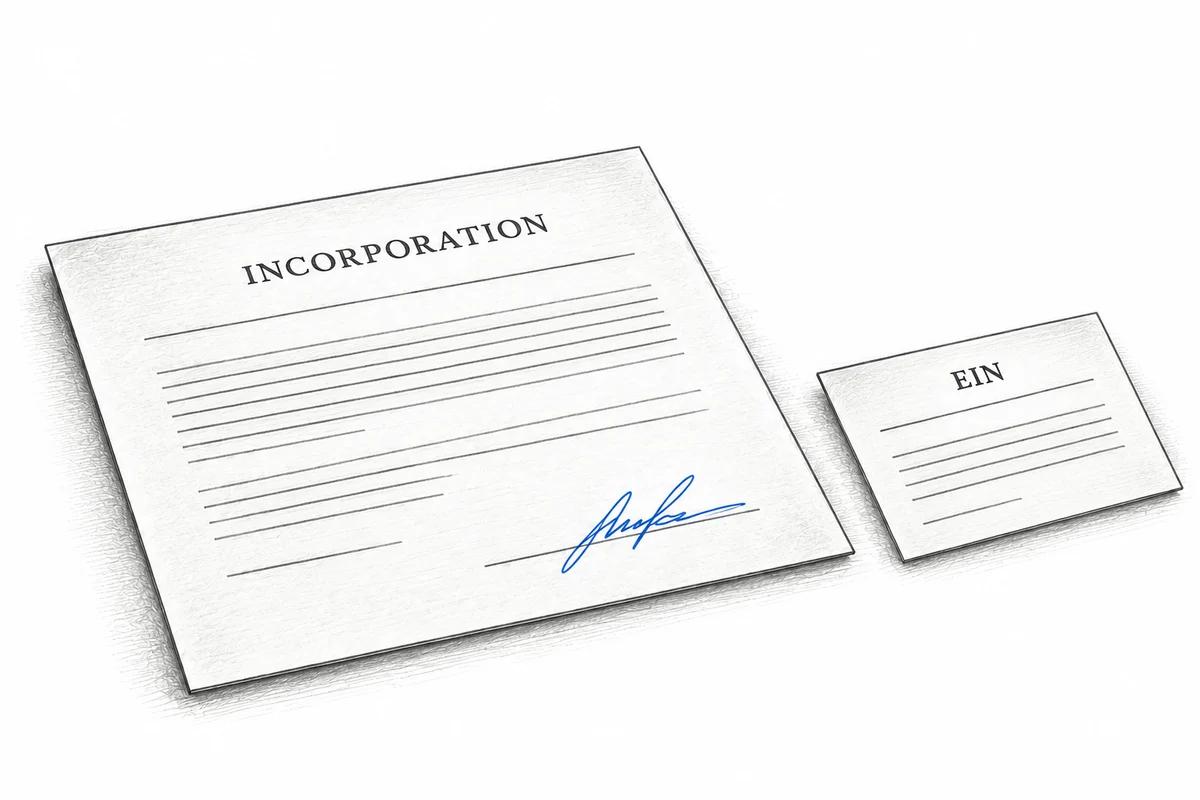
- Day 0Incorporate and issue founder stockSign IP assignments the same day.
- Week 1EIN, bank account, D-U-N-S numberThe EIN takes minutes. D-U-N-S can take days.
- Day 3083(b) election must reach the IRSNo extensions. Generally can't be revoked.
- Every March 1Delaware franchise tax and annual reportLate filing costs $200 plus interest.
Pick the right entity
If you plan to raise venture capital, form a Delaware C-corporation. That is an investor expectation, not a legal requirement. Their standard documents (SAFEs, preferred stock, option plans) are built around it, and Delaware's business courts and case law are the most predictable in the country.
An LLC can make sense for a bootstrapped, cash-flow business you never plan to raise money for. Converting later is possible, but it costs legal fees and time right when you'd rather be closing a round. Our LLC or Delaware C-Corp guide covers the choice in depth.
Issue founder stock, with vesting
Issue founder shares at formation, while the company is worth essentially nothing. The industry norm is four-year vesting with a one-year cliff: nothing vests for 12 months, then a quarter vests at once and the rest vests monthly.
Vesting protects you. If a co-founder walks away in month four, the company can buy back their unvested shares instead of carrying an absent owner forever. Investors will ask for it anyway. Read more about founder vesting.
File your 83(b) election within 30 days
When you buy stock that vests over time, an 83(b) election tells the IRS to tax you on its value today, which is almost nothing, instead of on its value each time it vests, which could be a lot if the company grows.
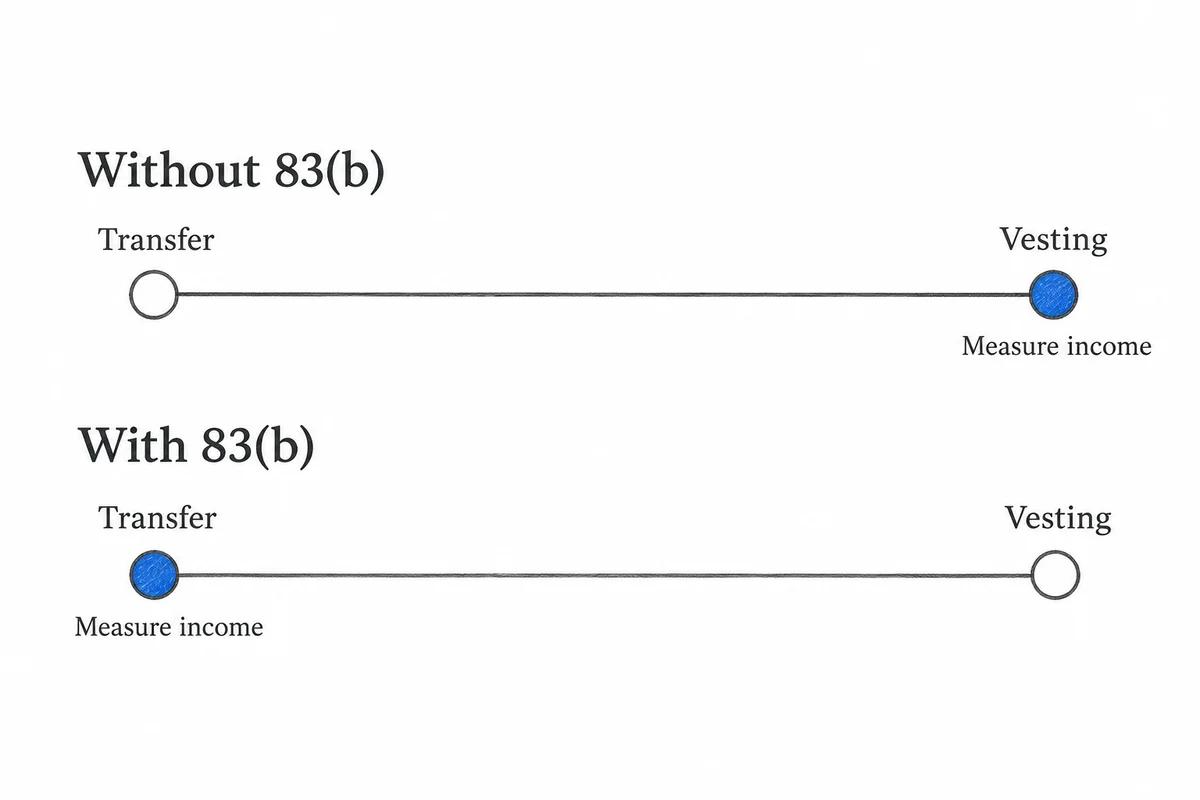
- It must be filed within 30 days of receiving the stock. There are no extensions, and it generally can't be revoked.
- You can use IRS Form 15620 or a written statement. Keep proof of timely filing.
- Filing it with your company doesn't count. It has to reach the IRS.
Miss it, and you may owe tax on income you never received in cash. Our 83(b) election guide walks through the filing itself.
Protect your IP
Everyone who has written code, designed screens or created anything for the product should sign an agreement assigning that work to the company: founders, early contractors and the friend who built the prototype. Investors check this during due diligence, and a missing assignment can stall a round.
Set up the basics
| Item | What it is | Watch out for |
|---|---|---|
| EIN | Your company's tax ID | Free from the IRS and issued online in minutes. |
| Registered agent | A Delaware address that receives legal notices | Required for every Delaware company, and renewed yearly. |
| Bank account | Keeps company money separate from yours | Mixing personal and company money weakens your liability protection. |
| D-U-N-S number | A free business ID from Dun & Bradstreet | Apple requires one to publish under your company name, and so do Google Play organization accounts. Request it early. |
| State registration | Registering where you actually work | A Delaware company with an office in another state usually has to register there too. |
The post-incorporation checklist covers each of these in order, and registering where you operate covers state registration.
Don't panic at your first Delaware tax bill
Every Delaware corporation owes an annual report and franchise tax by March 1. The annual report fee is $50, and missing the deadline costs a $200 penalty plus 1.5% interest per month.
Delaware's default calculation, the Authorized Shares method, charges by the number of shares your charter authorizes, and most startups authorize millions. Recalculate with the Assumed Par Value Capital method, which looks at your assets instead, and the bill usually drops to the $400 minimum. See Delaware franchise tax, explained.
You don't have to assemble all of this by hand. This is the part Corply does: Delaware incorporation, founder stock with vesting, 83(b) preparation and the yearly filings, in one place, with every deadline tracked. You can do it in the browser or from the AI assistant you already use.
4 · Design it, then build it
Changing a screen in a design file takes minutes. Changing it once it's built, tested and shipped takes days. So design first, test the design, then write code.
- Map the user flow. Every screen from first open to the payoff in your core loop. If it takes more than a handful of steps, simplify.
- Wireframe it. Boxes and labels, no colors. You're deciding what goes where, not how it looks.
- Make it clickable and test it. Put the prototype in front of five real users. Don't explain anything. Just watch.
- Then make it beautiful. People judge an app's quality in seconds, before they've used a single feature.
Choose boring, proven technology
- Use managed services for the solved problems: authentication, payments, email, file storage, analytics.
- Go cross-platform when it fits. React Native and Flutter let one codebase serve iOS and Android. Go native when the product depends on heavy device features or top-tier performance.
- Start with one simple backend, not a fleet of microservices.
- Use AI coding tools for speed, not judgment. Security, data handling and architecture still need an experienced engineer reviewing every line.
Decide who builds it
| Option | Best when | Watch out for |
|---|---|---|
| Technical co-founder | You can find one who's all-in on the problem | Searching for months instead of building, or giving equity to the wrong fit |
| Build it yourself | You're technical, or the MVP is simple enough for no-code tools | Outgrowing no-code tools right as you get traction |
| Freelancers | The scope is small and very well defined | You become the project manager, designer and QA team |
| Agency | You need a defined build delivered to a spec | Agencies build what you specify, even when the spec is wrong |
| Product studio | You want strategy, design and engineering as one team, from idea through launch | Make sure you own the code and the roadmap |
Whoever builds it, the company owns the code repository, the domain, the cloud accounts and the app store listings, every person who touches the product signs an IP assignment, and you see working software every week or two.
5 · Launch: it’s a sequence, not a day
Strong launches are built in the weeks before: a private beta, a waiting list of people you've already talked to, and store listings that pass review the first time.
Run a private beta first
Invite 20 to 50 people, starting with the ones from your validation interviews. Use TestFlight for iOS and Google Play's testing tracks for Android. Fix what confuses them, not what they politely suggest.
Get through app store review
- Use an organization developer account. Apple's program costs $99 a year and Google Play charges a one-time $25; both need your company's D-U-N-S number for an organization account. New personal Google Play accounts must run a closed test with at least 12 testers for 14 straight days before publishing; organization accounts generally don't.
- Have a privacy policy URL ready. Both stores require one, along with accurate answers about what data you collect.
- Let users delete their account in the app. Apple requires it for any app that lets people sign up.
- Plan for at least one rejection. Read the reason, fix it, resubmit. Don't schedule your announcement for the day you first submit.
Launch week checklist
- Analytics confirmed working on a real device
- Crash reporting turned on
- Store screenshots and a description that sell the payoff, not the features
- A personal email to everyone from your validation list and waiting list
- Posts in the two or three communities where your users already gather
- A way for users to reach you directly, and a promise to answer within hours
Early users almost never come from the launch post alone. They come from the people you talked to in step 1, from communities you've genuinely taken part in, and from personal emails, demos and onboarding calls.
6 · After launch, measure what matters
Launching proves you can ship. What comes after proves whether you have a business. The question is no longer “will people try it?” but “do people come back?”
- Activation: the share of new users who reach the payoff in their first session. If this is low, fix onboarding before anything else.
- Retention: of the people who signed up in a given week, how many are still active after 1, 7 and 30 days?
- One north-star metric: the single number that best captures value delivered. Bookings completed, invoices sent, workouts logged.
Ignore downloads, total signups and page views as signs of success. They're easy to grow and tell you very little.
A quick product-market fit gut check
Ask active users, “How would you feel if you could no longer use this product?” A widely used rule of thumb from growth marketer Sean Ellis says that when about 40% or more answer “very disappointed,” you're onto something. It's a heuristic, not a law.
When to raise money
Raise when money speeds up something that's already working, not to find out whether anything works. Early evidence (retention, revenue, a growing waitlist) gives you leverage on terms.

Most pre-seed and seed rounds today use SAFEs, usually the post-money version popularized by Y Combinator. Understand the valuation cap and how much of the company you're selling before you sign. Our guide to what a SAFE is works through the math. Keep your cap table clean from day one; every shortcut in step 3 shows up here.
Where to start
None of these steps is hard on its own. What's hard is doing all of them, in the right order, while also trying to build something people love.
Corply handles the “make it official” step: Delaware incorporation, founder stock and vesting, 83(b) preparation, and the filings and deadlines that follow. For the product itself, product studios such as Kanopy Labs, which has shipped about 50 products, take founders from idea to launch.
Start your Delaware C-Corp
Complete your application in the browser. Review your documents and price before you sign and pay.
Prefer your AI assistant? Connect Corply or share the https://corply.dev/skills.md raw guide.
FAQ
- How long does it take to go from idea to launch?
- For a focused first version, plan on roughly 2 to 4 weeks of validation and 8 to 12 weeks of design and build. Delays usually come from scope creep, not engineering.
- Do I need to incorporate before I start building?
- Incorporate before you take money, sign contracts, bring on co-founders or contractors, or launch publicly. If you have co-founders, do it early. Founder stock, vesting and the 83(b) clock all start at formation, and they are cheapest when the company is worth nothing.
- Should I form an LLC or a C-corp?
- If you plan to raise venture capital, a Delaware C-corp is what investors expect. An LLC can suit a bootstrapped business with no plans to raise.
- How much does an MVP cost?
- It depends on scope and platforms. A focused MVP from a professional team usually runs from the tens of thousands to the low six figures, with complex products like marketplaces at the top of that range. Tight scope is the biggest lever you have on cost.
- Do I need a technical co-founder?
- No, but someone experienced has to own the technical decisions. That can be a co-founder, a senior hire, or a product studio that works like part of your team.
- Can I launch on iOS and Android at the same time?
- Yes. Cross-platform frameworks like React Native make that practical for most apps. If your budget is tight, launching first on the platform your users prefer is still a good call.
- What is the most common paperwork mistake?
- Missing the 30-day 83(b) deadline. It cannot be extended, and the tax consequences can follow you for years.
Primary sources
- Delaware Division of Corporations: annual franchise tax
- Delaware Division of Corporations: how to calculate franchise taxes
- IRS Form 15620: Section 83(b) Election
- IRS: get an employer identification number
- Apple Developer Program: enrollment
- Google Play Console: app testing requirements for new personal developer accounts
This page is general education, not legal or tax advice, and reading it does not create an attorney-client relationship. Corply is operated by 0Lumen Labs Corp., is not a law firm, and routes questions that need individualized judgment to licensed professionals. Rules and fees change, so verify current requirements with the relevant state, the IRS, or your counsel.