Founder guide
A clean startup cap table: prove every share before you raise
A cap table answers two questions: who owns the company today, and who could own it after a financing. Both answers need documents behind the numbers.
By Corply · Updated
1. Know what the numbers actually mean
When an investor buys shares, everyone’s percentage depends on how many shares and rights already exist. A missing grant can change the deal. A clean cap table therefore connects each holding to approvals, agreements and completed transactions. Keep current ownership separate from the proposed financing. This guide covers U.S. corporations, with Delaware rules where specified.
Five numbers founders mix up
- Authorized shares: the ceiling your charter permits, by class. Authorization leaves room for future issuance; it does not give anyone ownership.
- Issued shares: shares the company has actually issued and hasn’t retired.
- Outstanding shares: issued shares held outside the company. These are the starting point for current ownership.
- Treasury shares: previously issued shares the company reacquired and still holds. Delaware excludes the company’s own shares from voting and quorum counts.
- Fully diluted shares: a model assuming specified instruments become stock, usually including the remaining option pool. It helps compare ownership after those claims are counted. State the assumptions; deal documents control the definition.
An option is a right to buy shares. A SAFE promises future equity under its terms. Neither belongs in the current stockholder count before exercise or conversion. See the SEC’s instrument definitions, Delaware’s stock rules, and Cooley’s denominator explanation.
Worked example: 50% of what?
Hypothetical company: 10 million shares authorized; founders hold 5 million and 3 million; no treasury shares. There are 400,000 outstanding options and 600,000 shares left in an approved option pool. No other securities.
| Measure | Calculation | Result |
|---|---|---|
| Founder A’s current ownership | 5m ÷ 8m outstanding | 62.5% |
| Founder A, fully diluted including the pool | 5m ÷ (8m + 0.4m + 0.6m) | 55.56% |
| Founder A as a fraction of authorized shares | 5m ÷ 10m | 50%, not current ownership |
Now add a $200,000 YC post-money SAFE at a $4 million cap. If it converts at that cap, the implied ownership sold is 5% before the new priced-round money and related pool increase. That is a conversion scenario, not five percent of today’s outstanding stock. YC explains the assumptions.
The evidence checklist
- Charter and amendments: authorized classes, counts and par value.
- Each stockholding: holder, class, share count, date, approvals, signed agreement and evidence the required consideration was delivered.
- Vesting and founder departures: schedules, amendments, transfers and completed repurchases. Unvested shares can already be owned. Never erase them merely because someone leaves.
- Options and convertibles: grant approvals, exercise records, signed SAFEs or notes, side letters and funding evidence. Keep promises awaiting approval separate.
- Reconciliation: match the documents to the stock ledger, then explain every difference in the investor model.
Delaware’s stock ledger records stockholders, addresses, holdings, issuances and transfers. A financing projection answers a different question: what ownership would look like if the proposed deal closes. Missing approval or disputed ownership needs counsel’s review, not a backdated spreadsheet entry. Delaware §§219 and 224.
2. Use Corply to keep the evidence and actions together
Through Corply MCP, you can read the append-only stock ledger with supporting-document references, plus a separate SAFE register showing amounts, status, pending signatures or payments, and ownership if converted at the cap. Check whether a cap-table view is projected and whether its percentages use authorized or recorded shares before forwarding it.
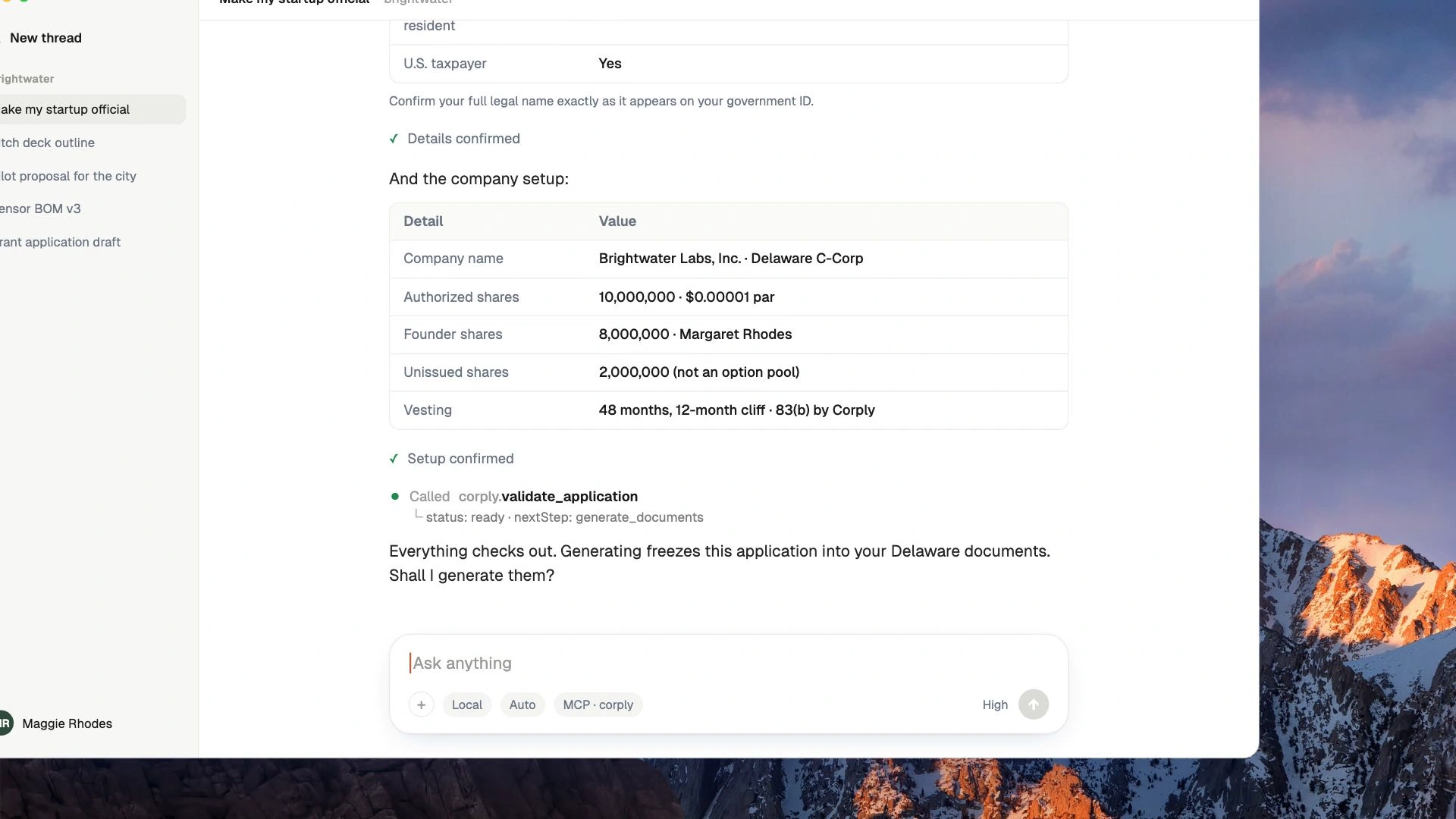
Already incorporated elsewhere? Upload the company PDFs through the import flow. Corply proposes facts with source quotes and pages; you confirm or correct them, then Corply reviews the documents. Imported facts don’t themselves issue shares. Earlier SAFE rounds can also be recorded with their signed-document references and marked as imported records.
For an eligible Corply-formed Delaware C-corp, you can propose restricted-stock purchases, supported common-stock sales and SAFE rounds. Corply prepares the relevant approvals and agreements, sends personal signing links after authorization, and tracks completion. Each person reviews and signs their own document. Payment-backed issuance requires verified settlement; “the investor paid” in chat won’t close it.
Need more authorized shares? Corply routes its supported charter amendment through board and stockholder approvals, a filing quote and state acceptance. Paying the quote doesn’t increase the share count. SAFE workflows also track applicable most-favored-nation notices, which concern access to later investment terms.
Ask Corply which actions your company can use before promising a closing date. Imported-company equity workflows have restrictions; payment collection requires an enabled, onboarded Corply Pay account. Keep counsel involved for disputed records, unusual terms and the financing’s final dilution model.
This page is general education, not legal or tax advice, and reading it does not create an attorney-client relationship. Corply is operated by 0Lumen Labs Corp., is not a law firm, and routes questions that need individualized judgment to licensed professionals. Rules and fees change, so verify current requirements with the relevant state, the IRS, or your counsel.