
The steps
Forming a startup takes a short sequence of steps, each depending on the one before. You choose a name and confirm it is available in Delaware and does not infringe a trademark. You file the certificate of incorporation, and the company exists once the state accepts it. The incorporator names the first board. The board, usually by written consent, adopts the bylaws, appoints officers, approves the founders' stock purchases and authorizes a bank account. Each founder signs a restricted stock purchase agreement that sets their vesting and assigns their prior work to the company, and pays for their shares, which at formation prices is a small amount. Each founder files an 83(b) election within 30 days of the purchase. Finally the company gets an EIN from the IRS and opens a bank account.
Corply prepares the charter, bylaws, board consent and stock agreements together, collects each founder's signature, has a person on its team review the filing before it goes to Delaware, prepares the EIN application and tracks each 83(b) deadline.
Standard formation does not need a lawyer. Unusual situations do: a founder who built the product while employed elsewhere, an existing company in the United States or abroad, a founder who is not a U.S. tax resident, an unusual equity arrangement, a disagreement between founders, or an investor who has already been promised special terms. Raise those before you file, while they are still cheap to fix.
Splitting the equity
There is no formula for dividing a company among its founders, and the standard advice is consistent: decide early, decide based on what each person will do from here rather than what they have done, and stay close to equal unless there is a clear reason not to.
Nearly all of the company's value will come from work that has not happened yet. A founder who spent three months on a prototype has contributed something, but far less than the years ahead. Splits that reward whoever had the idea or wrote the first code tend to look unfair to everyone two years later. Good reasons for an unequal split include a real difference in expected commitment, one founder joining well after the others, or one founder putting in significant money or assets. Whatever you decide, write down why, and if the reasons change, say because a founder goes part-time, revisit the split before it turns into resentment.
Most startups authorize 10,000,000 shares and issue about 8,000,000 to the founders, leaving 2,000,000 for early advisors, employees and investors. Two founders splitting equally each buy 4,000,000 shares. Some teams give one founder a single extra share so that the founders cannot deadlock 50-50 as stockholders. A deadlock between equal founders usually signals a deeper problem that one share will not solve, but it can keep the company functioning while the problem is worked out.

Vesting
Founders buy all their shares on the first day, but the company keeps the right to buy back the unvested portion, at the price the founder paid, if the founder leaves. Each month the founder stays, more shares are released from that repurchase option, until all of them are vested. Because the founder owns the shares from the start, this is sometimes called reverse vesting.
The standard schedule is four years with a one-year cliff: nothing vests in the first year, a quarter vests on the first anniversary, and the rest vests in equal monthly amounts over the next three years. Corply uses this schedule by default.
Vesting protects founders from each other. Without it, a cofounder who leaves after three months keeps the same stake as the one who stays seven years, and the company must give away more equity to replace them. Almost every venture investor requires founder vesting before investing, so putting it in place at formation means you choose the terms instead of negotiating them in a financing. Some teams credit founders for time spent before incorporation by starting the vesting clock on the date they began working full time together. That is reasonable when the work was real and full time, though investors may push back on large credits.
If a founder leaves before fully vesting, the company has a set window to buy back the unvested shares. Under Corply's agreement the window is two months, and the repurchase happens automatically at the end of it unless the company says otherwise, so nobody has to remember to act. The company pays the founder what they originally paid for those shares, which at formation prices is a few dollars, and the founder keeps the vested shares. Leaving the board and giving up an office are separate steps, covered in When the team changes.
Acceleration speeds up vesting when certain things happen. Corply's agreement uses double-trigger acceleration: if the company is acquired and, within the following 12 months, the founder is terminated without cause, or a founder who is a director is removed from or not re-elected to the board, all of the founder's unvested shares vest. Single-trigger acceleration, which vests shares on the sale alone, is much less common because acquirers want the team to stay. The hiring chapter covers acceleration for employees.
83(b) elections
Under Section 83 of the Internal Revenue Code, stock that can be taken back if you leave, which is what unvested stock is, is normally taxed as it vests. Each time shares vest, you owe ordinary income tax on their value that day minus what you paid. If the company does well, that value climbs, and you owe tax on paper gains every month for four years without having sold anything.
An 83(b) election lets you be taxed when you buy the stock instead. You report the difference between the stock's value at purchase and what you paid, and for founders buying at formation at full value that difference is zero, so the election costs nothing. From then on vesting is not a taxable event, future growth is taxed as capital gain when you sell, and your holding periods, including the one for qualified small business stock, start at purchase.
The election is not free in every case. If you pay less than the stock is worth, you owe tax on the difference now, and if you file and then leave before vesting, you cannot deduct the tax you paid on shares the company takes back. For founders at formation neither is usually an issue, which is why filing is standard.
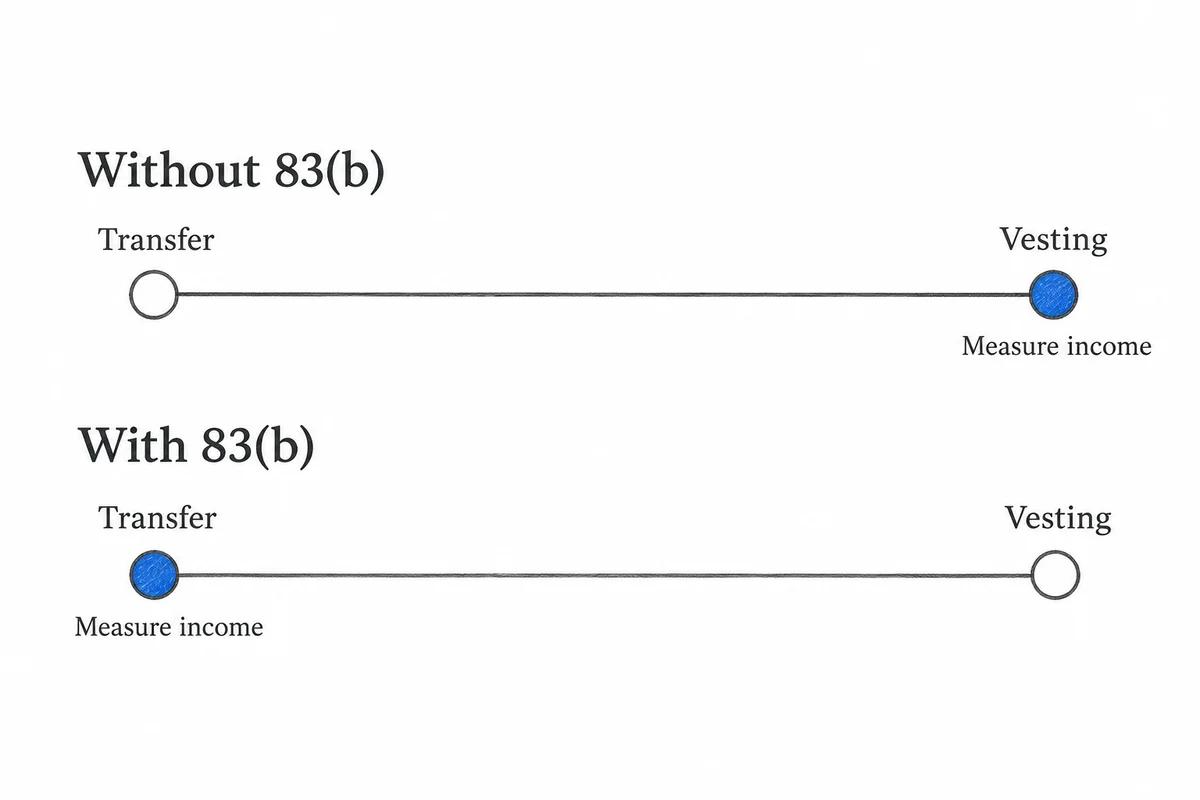
The election must reach the IRS within 30 days after the stock is transferred to you. The deadline cannot be extended and missing it cannot be fixed. If the 30th day falls on a weekend or federal holiday, the deadline moves to the next business day, and a mailed election counts as filed on the date it is postmarked, so send it by USPS Certified Mail and keep the receipt. You can file Form 15620 online through an IRS Online Account, after verifying your identity, or mail a signed Form 15620 or equivalent written statement to the IRS office listed in the form's instructions. Either way, give the company a copy and keep your proof of filing; you no longer have to attach a copy to your tax return. Corply prepares a filled-in election for each founder, reminds you before the deadline and records your proof.
Paying for shares, and paying for things
Founders pay for their shares. At formation the price is par value or a little more, so the total is usually under a hundred dollars each, and paying in cash keeps the record simple. Some agreements also count the founder's assignment of prior work toward the price, which documents that the company received something real for the stock.
Founders often pay early company expenses from their own pockets, and that money should be handled deliberately. The company can reimburse documented business expenses once it has funds. A founder can lend money to the company under a written note so it can be repaid. Or a founder can invest on the same terms as outside investors, through a SAFE for example, once there is a round. What you should not do is pay company bills from personal accounts with no record, which blurs the line between you and the company and leaves gaps in the books.
Stock plans
A stock plan is a document, adopted by the board and approved by stockholders, that lets the company grant options, restricted stock and other awards to employees, advisors and consultants. It reserves a number of shares, the option pool, for those grants.
You do not need one at formation; adopt it when you are about to make your first grant to someone other than a founder, and get a 409A valuation before the first option grant so you can set the exercise price. To grant incentive stock options, stockholders must approve the plan within 12 months before or after the board adopts it. Seed-stage pools are often 10 to 15 percent of the fully diluted shares, and investors in a priced round frequently ask for the pool to be enlarged before they invest, so that the new shares dilute the existing holders rather than them. Plans usually run ten years, which is also the longest term an incentive stock option can have. The hiring chapter covers what to grant and how.