
How to file an 83(b) election before your 30 days run out
By Corply · Updated
Stock can pay you for work before it pays you any cash. An 83(b) election changes when restricted stock creates compensation income. Decide when the shares transfer.
1. Why stock can create a tax bill before you sell it
A company can compensate you with shares instead of cash. U.S. federal tax rules still treat the value you receive for services as income. Founder shares often come with vesting: you own them, but the company can buy back the unvested portion if you leave. That restriction affects when the compensation is taxed.
Normally, restricted stock creates compensation income as it becomes substantially vested. An 83(b) election chooses to measure that income when the stock transfers instead. In either case, subtract what you paid from fair market value at the relevant date. IRS restricted-property rules.
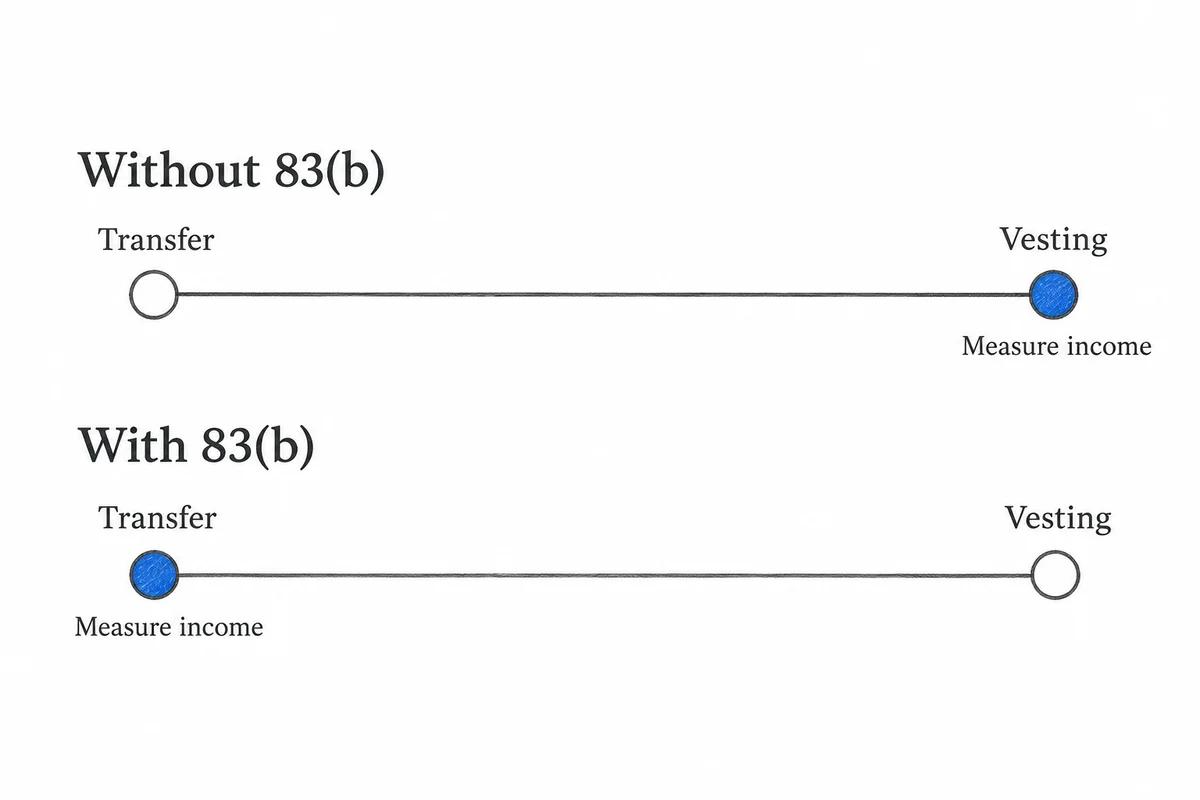
Why an early election can matter
Fair market value is the shares’ supportable value at that time. Par value is a nominal charter amount, not a valuation. Paying a tiny price does not prove the shares have a tiny value.
Hypothetical: you buy 100,000 restricted shares for $100, their fair market value. They all vest a year later, worth $100,000. You have sold nothing.
| Choice | Compensation income |
|---|---|
| Valid, timely 83(b) | At transfer: $100 value minus $100 paid = $0. No extra compensation income at vesting. |
| No election | At vesting: $100,000 value minus $100 paid = $99,900. The bill can arrive before any sale. |
Compensation is ordinary income, the category that includes wages. A later sale can produce capital gain under either route. Your tax basis, the amount subtracted from sale proceeds, generally includes the purchase price plus compensation already recognized. The same appreciation is not simply counted twice. IRS basis rules.
The holding period generally begins just after transfer with an 83(b), or just after vesting without one. Long-term capital gain generally requires holding for more than one year. Filing does not guarantee a lower tax rate or tax-free exit. Holding-period rule; IRS capital gains explanation.
The risk runs both ways. Elect on shares worth more than you paid, then forfeit them, and you generally cannot deduct the compensation already recognized. You might pay tax on value you never keep. IRS forfeiture rule.
An ordinary option grant usually transfers no shares, so an election on the option itself is generally ineffective. Early exercise can transfer unvested shares and create an election decision. Incentive stock options need separate alternative minimum tax analysis. Fully vested stock has no remaining service-based restriction to elect around. IRS equity guide.
The 30-day filing checklist
- Confirm the actual transfer date from executed stock records. Signing, payment, incorporation and vesting dates can differ. File within 30 days after transfer; IRS instructions address weekends and legal holidays.
- Check identity, shares, restrictions, price and value. Complete and sign Form 15620 or a compliant statement. Give the company the required copy.
- Use the IRS online form with your own IRS Online Account, or mail to the office specified by current instructions. Save the election and submission confirmation or dated mailing proof.
- Do not wait for the company’s EIN: Form 15620 Box 9 is optional. Your own taxpayer number is different. Missing identification or cross-border facts need prompt tax advice.
Use Form 15620 instructions and the IRS online filing guidance. A prepared PDF is unfinished work.
2. How Corply carries the decision through to evidence
Ask Corply: “Show my stock transfer date, 83(b) deadline, filing choice and the exact step still waiting on me.”
Connect Corply to your assistant. If you untick Corply's filing, your agent can still open the IRS form, fill known details from your saved formation and stock records, and guide each next action. You personally sign in, complete ID.me verification if needed, review, sign and submit, and Corply keeps reminders active until your filing proof is reviewed. Fully vested stock skips the election workflow.
If you file it yourself
You need an eligible IRS Online Account. First-time ID.me verification can require a phone, fresh ID photos and a live video selfie or verification call. Your agent fills known non-secret fields and guides the current step; passwords, taxpayer numbers, identity capture and signing stay in private user takeover. If the host cannot control the browser, it guides a manual handoff. Keep the submitted election, provide the required company copy, and save redacted filing proof for Corply review. If online access is unavailable, use the current IRS paper instructions before the deadline.
Corply files it ($70)
Review and sign your Founder Formation Authorization. Its narrow authority lets Corply generate and execute the election after your restricted stock purchase agreement is completed, using the recorded transfer date. No second signature in this standard path.
Corply’s formation election assumes fair market value equals the purchase price. If that is wrong, resolve it with Corply and your tax adviser before authorizing.
Enter your SSN or ITIN on the private secure page and authorize its use for mailing. The form currently requires a nine-digit identifier; contact Corply if you lack one. Never use a placeholder or put it in chat. Ops prints and mails the election. Completion requires its Certified Mail receipt, which documents submission rather than IRS approval.
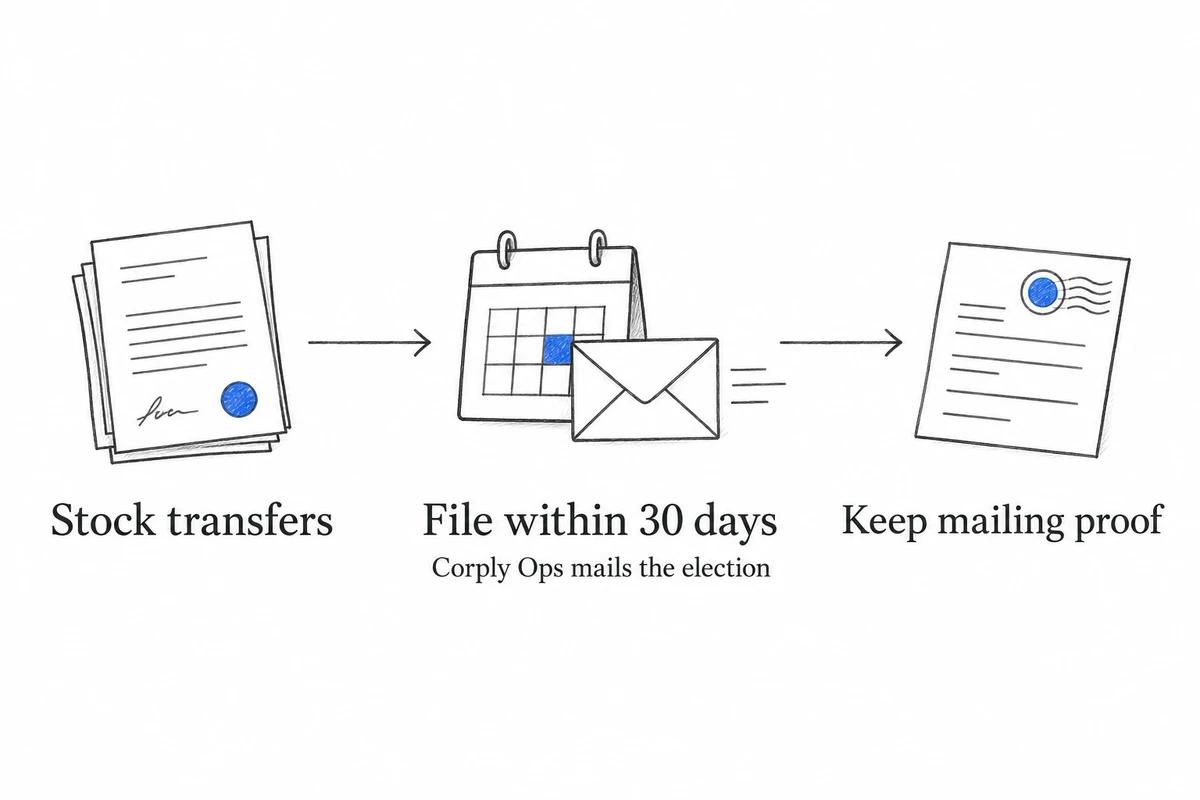
A later stock purchase
Keep a copy of your signed election and filing evidence. Ask Corply for the actual mailing status before assuming the deadline is handled.
For eligible later stock issuances, Corply connects board approval, signatures, verified consideration, the stock ledger and a new election task. The share payment page includes Corply filing the purchaser's 83(b) for $70, ticked by default; the purchaser can untick it. Service payment does not establish that stock transferred or an election was mailed.
Ask Corply: “Show the filing evidence. If it is pending, tell me who must act before the deadline.”
The filing packet below covers the taxpayer-number requirements and the proof to keep.
The filing packet, mailing and proof
A completed form sitting on your laptop has not been filed. Check the actual transfer date against your executed stock agreement and issuance records. Incorporation, vesting commencement and stock transfer can happen on different dates. File no later than 30 days after transfer; the IRS instructions explain weekends and legal holidays. Filing the election and paying any resulting income tax follow different deadlines.
- Confirm your name, address and taxpayer identification number, the shares and restrictions, transfer date, price paid and fair market value. [Par value does not establish fair market value.](#tax-before-cash)
- For online filing, open IRS Form 15620. It requires an IRS Online Account. Personally complete the identity check, review, signature and submission. Save the submitted form and success confirmation.
- For paper filing, complete and sign Form 15620 or a compliant election prepared for your facts. Use the IRS office specified by the form instructions for your individual return. The company’s Delaware registered office does not determine the mailing destination.
- Give the company a copy of the signed election. If the person performing services and the person receiving the property differ, the instructions also require a copy for the recipient.
If you use paper, plan for proof
For a mailed election with an IRS acknowledgment request, prepare the signed election, an acknowledgment copy and a short cover letter requesting its return. Enclose a smaller, self-addressed envelope with prepaid return postage. Put these inside the outbound envelope and pay postage for the complete packet’s actual size and weight.
Corply’s managed route uses standard USPS First-Class Mail with Certified Mail. If using that mailing method yourself, keep the dated USPS acceptance receipt, a copy of the packet, tracking and delivery evidence. Buying postage or printing a label alone does not prove the postal service accepted the packet.
The IRS mailroom instructions describe returning an acknowledgment when a stamped, self-addressed envelope is enclosed. That acknowledgment differs from the optional USPS Return Receipt service. Do not wait for either to preserve timely-filing evidence; neither is a ruling that the election is legally valid.
If you do not have an SSN or ITIN
The form asks for your taxpayer number. Do not substitute the company EIN, another person’s number or a placeholder. Corply’s managed secure form currently requires a nine-digit SSN or ITIN. Ask a qualified U.S. tax advisor promptly about your filing route. Getting an EIN for the company neither supplies your personal taxpayer number nor extends the election deadline.
A prepared form or paid service does not prove filing. Contact Corply promptly if a deadline is close and mailing evidence is missing, and coordinate any independent submission first to avoid duplicate filings.
This page is general education, not legal or tax advice, and reading it does not create an attorney-client relationship. Corply is operated by 0Lumen Labs Corp., is not a law firm, and routes questions that need individualized judgment to licensed professionals. Rules and fees change, so verify current requirements with the relevant state, the IRS, or your counsel.